The tradition of Ganesha worship was deeply
intertwined with farming cycles and reverence for nature long before it became
commercialised. Taking clay from one's own land and returning it after worship
represented a complete cycle of gratitude: "God, I created you from
your soil, and you have returned to it. Please watch over my crops and
harvest." Traditional rituals
carried deep ecological wisdom. During the ritual bath (Abhishek),
pouring Panchamrit and 21 medicinal leaf extracts over the clay idol allowed
these organic elements to dissolve into the soil. Honey generated natural
warmth, while fermented curd added beneficial bacteria, turning the idol into a
bio-fertiliser. When immersed, it naturally enriched local water bodies and
soil, perfectly blending faith with environmental harmony.
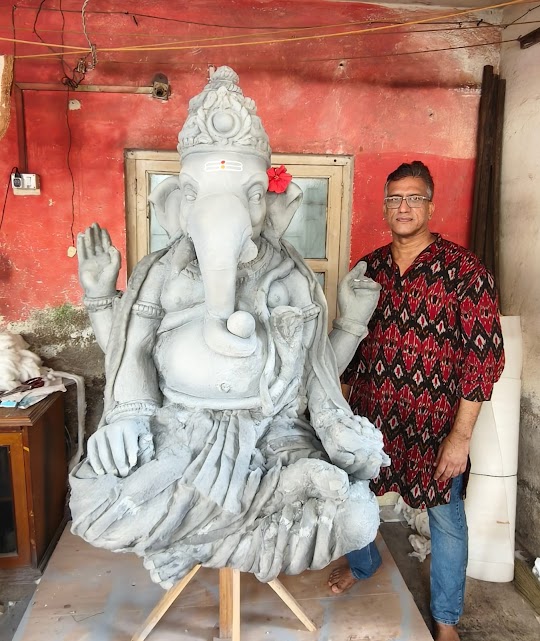
"Every artist putting work into a
creation, especially of Lord Ganesha, pours their heart, soul, and faith into
it... As an artist, I feel the responsibility for what happens after immersion
lies with us," says Dilip Vaity, the artist and founder of Vishwavinayak.
However, as populations grew and
commercial demand rose, the nature of these materials shifted. Field soil gave
way to Shadu clay, which, despite being natural, forms thick sediment layers
that can block underground water streams when immersed in large quantities.
Later, Plaster of Paris (PoP) emerged as a cost effective, lightweight
alternative that allowed for intricate details. Yet, because PoP does not
dissolve naturally, it leads to environmental distress.
"Every artist putting work into a
creation, especially of Lord Ganesha, pours their heart, soul, and faith into
it... As an artist, I feel the responsibility for what happens after immersion
lies with us," says Dilip Vaity, the artist and founder of Vishwavinayak.
His understanding is that the solution for
this lies in artistic leadership and mutual understanding. He advocates for
creative, sustainable alternatives, such as crafting idols from natural cotton.
Since cotton is a pure, plant-based element, an immersed cotton idol simply
compresses into a harmless ball that settles safely into soil or water. He
himself stopped using non-biodegradable thermocol for decorations back in 2003,
switching instead to wood, paper, silver, and gold. He also champions community
efforts that recycle floral waste into eco-friendly colors and transform
dissolved PoP from artificial tanks into useful bricks and plant pots.
This profound harmony between faith and
nature inspired Dilip Vaity’s painting series, "Morning Moryaa."
It is an activity he carries out on a daily basis, every morning, with only one
singular goal- an emotional and spiritual step towards serving for Ganesha
energy through his artistic heart.
"Lord Ganesha is a deity of
nature... His form is endless. People see His form everywhere, in a chili, in
the natural curve of a piece of wood, or in natural textures,” notes Dilip
Vaity.
Vaity captures Bappa’s presence organically within the world around us reminding us that true devotion lies in honoring and protecting the earth. When we honor the deity of nature with choices that nourish rather than harm our planet, we restore the true spirit of the festival