What Section 106C(5) means w.e.f. June 30, 2026
The often-disputed question in housing societies – who pays for what repair – has now got a clear legal backing. The Maharashtra government has notified strict implementation of Section 106C(5) of the Maharashtra Co-operative Societies Act, introduced via the 2019 amendment, applicable from June 30, 2026.
The move aims to end ad-hoc repair practices and bring transparency in how societies handle crores collected for maintenance, explains Thane Co-operative Advocates Association President Adv. Satnam Singh Rasgotra.
What Changes On Ground:
1. Clear Division of Responsibility
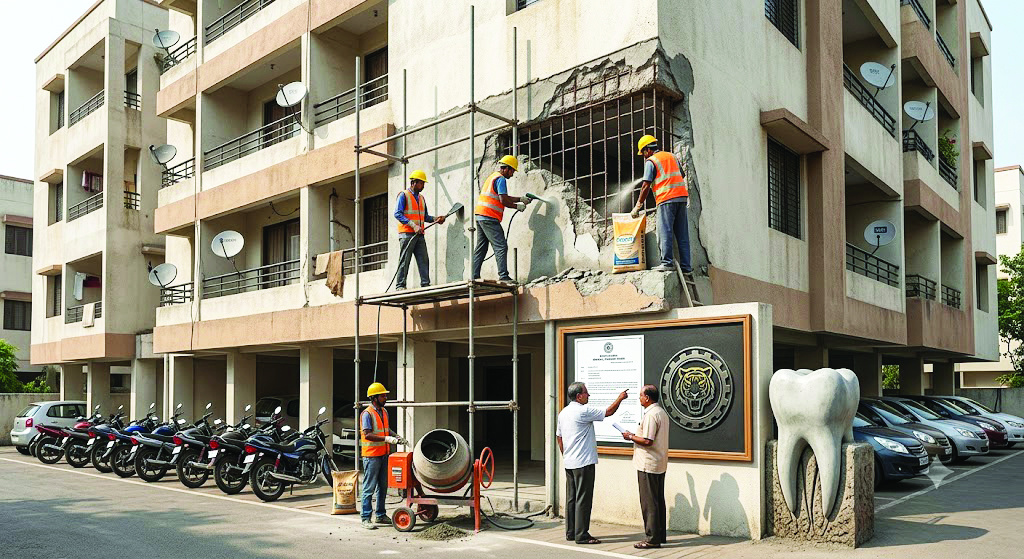
The Act now codifies liability. The society is responsible for structure, terrace, external walls, common areas, lifts, water tanks, compound, drainage, external painting and main pipelines. A member’s liability is limited to inside the flat – flooring, internal paint, kitchen/bathroom fittings, doors and windows. For instance, seepage due to a common pipeline will be society’s cost, not the flat owner’s.
2. Three Funds Now Compulsory
Every society must compulsorily create and collect three separate funds along with monthly maintenance:
- Sinking Fund: For major repairs after 15+ years
- Repair & Maintenance Fund: For annual upkeep
- Major Repairs Fund: For structural work
Failure to create these funds will invite action from the Registrar.
3. No More Diversion of Funds
In a first, the law mandates separate bank accounts for each fund and compulsory annual audit. The funds can be used ONLY for repair/maintenance. Members have the right to demand bills, utilisation certificates and audit reports on demand.
4. Committee Powers Curtailed
Any major or structural work will now require approval of a 3/4th majority in the General Body Meeting. The managing committee can no longer unilaterally award large repair contracts.
5. Remedy for Residents
If a society fails to carry out essential repairs, any member can complain to the Deputy Registrar, who can issue binding directions to the society to execute the work.
Before vs After 2019 Amendment:
Previously, there was no mandatory separate fund or audit rule and committees could spend freely. Now, separate funds are compulsory, audit is mandatory, structural audit is required every 5 years for buildings older than 15 years, and GB approval is must for major expenses.

Adv. Satnam Singh Rasgotra
President, Thane Cooperative Advocates Association