
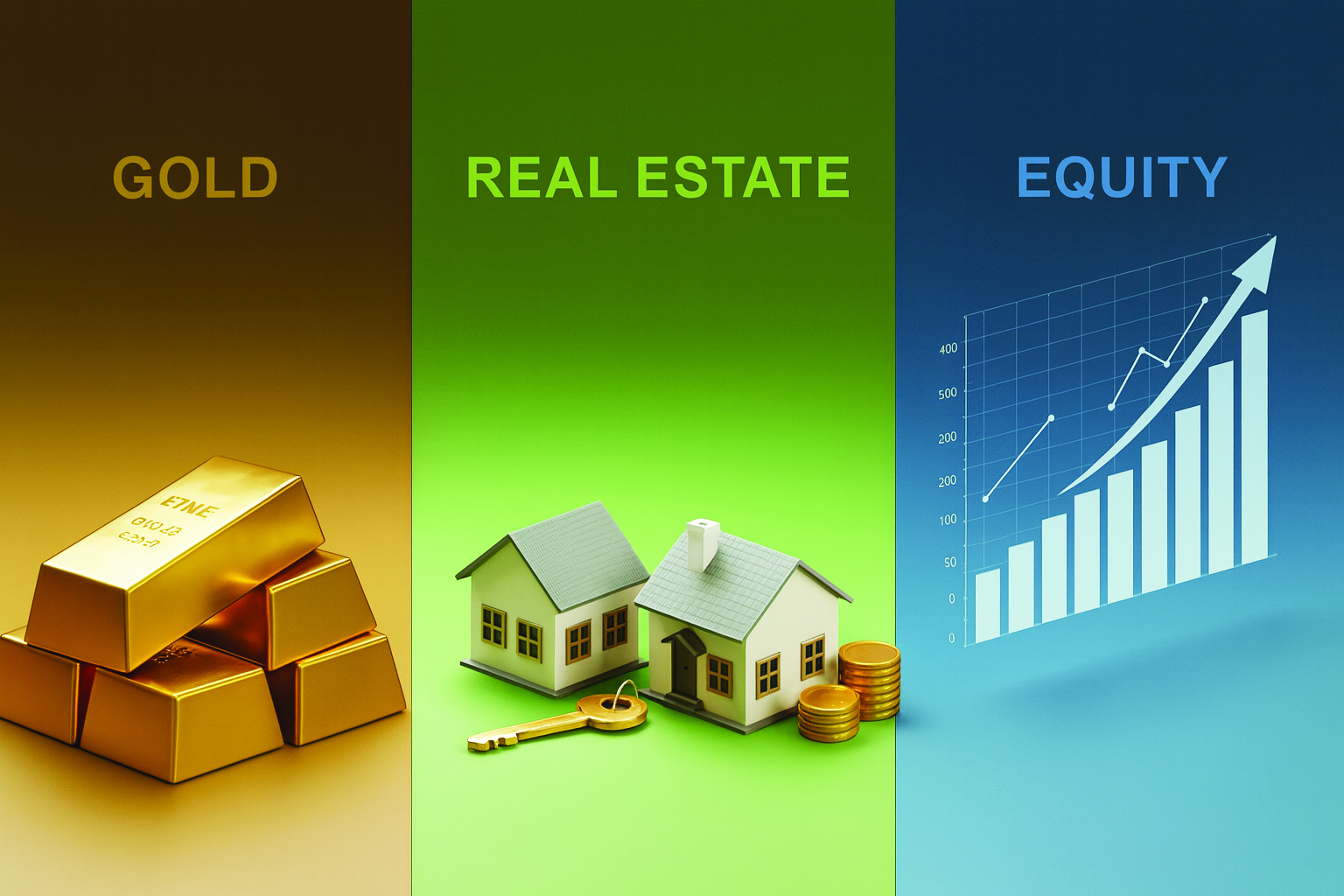
For decades, Indian households have lived by three universal beliefs:
“Buy property early.” “Gold never loses value.” “The stock market is risky.”
These ideas shaped how an entire generation invested.
But the last 20 years quietly rewrote India’s wealth-creation story.
Between 2005 and 2025, salaries grew, inflation rose, and the Sensex climbed from 6,000 to over 75,000. Families bought flats, many accumulated gold, and a smaller group consistently invested in equities. Today, the core question isn’t what to buy. It is:
Which asset actually created wealth and which one only looked safe?
This isn’t opinion. This is data.
Equity: The Silent Compounder That Beat Everything Else
Equity reflects India’s economic engine GDP growth, rising profits, consumption cycles, and entrepreneurship. From 2005–2025, India’s GDP grew nearly 8x, while the Nifty delivered ~14% CAGR, surviving crises like the Global Financial Crisis, Demonetization, and COVID-19.
A few powerful facts:
- No 7-year period since 1999 has ever delivered negative returns.
- Even the worst 7-year stretch gave ~5% CAGR.
- In 80% of 10-year periods, investors tripled their money.
Equity rewards patience. Time in the market beats every attempt to time it.
And unlike gold or real estate, equity offers:
- High liquidity
- Transparency
- Better tax efficiency
- Low cost of ownership
This is why disciplined, long-term equity investors quietly built far superior wealth.
Gold: India’s Emotional Safety Net Not a Wealth Multiplier
Gold is trust. It is a tradition. It shines brightest during fear 2008, 2012, 2020. And yes, over 20 years, gold’s CAGR (11–14%) comes close to equity.
But here’s the truth: gold grows in spikes, not in a straight line.
Between 2013–2018, gold was almost flat while equity doubled.
Gold protects purchasing power, but rarely accelerates it.
Gold is a hedge, not a wealth engine.
Real Estate: The Overrated Performer
Property appreciation in India averaged 8–9% CAGR over 20 years. Sounds good until you deduct:
- 8–10% stamp duty & registration
- Maintenance, repairs & society charges
- Property taxes
- Broker fees
- Zero liquidity during downturns
When adjusted for all costs, the actual IRR often falls below 6%.
As highlighted by data:
₹1 crore invested in Mumbai real estate in 2005 is worth ₹3–3.5 crore today.
The same ₹1 crore in equity mutual funds? ₹15–18 crore.
Real estate is not bad but it is illiquid, emotional, and location-dependent, not a compounding machine.
The Balanced Answer Enrichwise SRP Approach
At Enrichwise, we don’t say “avoid assets.”
We say: allocate smartly and rebalance with discipline.
Our SRP Strategic Rebalancing Plan ensures:
- Old Money → Protects gains during rallies
- New Money → Keeps SIPs flowing during market dips
- Rebalancing → Cuts risk at highs, adds equity at lows
You don’t need to predict the market. SRP helps you benefit from every cycle.
| Asset Class | 20-Year CAGR | Liquidity | Risk | Tax Efficiency | True Role |
| Equity | 14–15% | High | Medium | High | Growth |
| Gold | 11–14% | High | Low | Moderate | Hedge |
| Real Estate | 7–9% | Very Low | High
|
Low | Asset/Use |
A small difference of even 2–3% CAGR becomes multiple crores over 20 years.
That’s the difference between buying property and building lasting wealth.